
How to Cross the Street in Vietnam – A Comprehensive Guide for First-Time Travelers
Step-by-Step Guide to Crossing the Street Safely in Vietnam
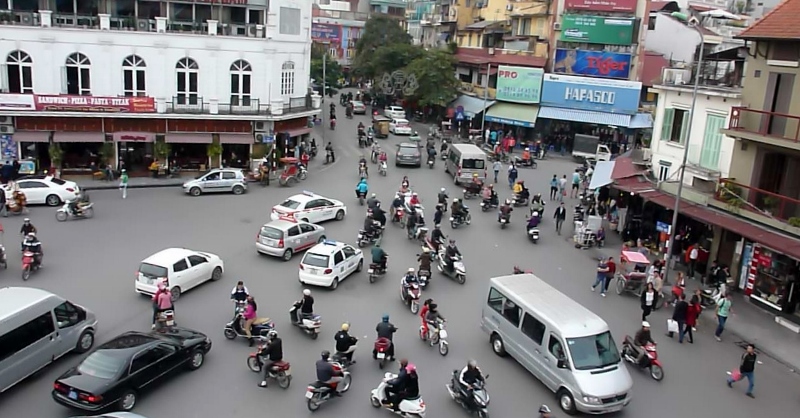
For many first-time visitors, stepping onto the pavement of Hanoi or Ho Chi Minh City feels like stepping into a choreographed whirlwind. With a national population of 100 million and roughly 40 million motorbikes, the sheer volume of two-wheeled traffic is staggering. In the bustling capital of Hanoi, the streets are a living, breathing organism where traffic laws often feel more like “suggestions” and the flow of vehicles never truly stops.
If you come from a country where vehicles come to a complete halt the moment a pedestrian touches a crosswalk, Vietnam will provide a significant cultural – and physical -jolt. However, navigating this “organized chaos” is a rite of passage. Once you master the technique, you’ll find that the traffic flows around you like water around a stone.
In this comprehensive Hanoi Travel Guide on how to cross the street in Vietnam, Golden Holiday Travel provides the ultimate survival kit for pedestrians, detailing the psychology of Vietnamese traffic and the proven techniques for crossing the street safely.
1. Understanding the Vietnamese Traffic Ecosystem
To cross the street effectively, you must first understand why the traffic behaves the way it does. Vietnam is a developing nation where, due to high luxury taxes and narrow urban infrastructure, cars remain a status symbol while motorbikes are the lifeblood of the economy.
The Paradox of “Disordered Order”
In cities like Hanoi, Da Nang, and Hai Phong, the traditional rules of the road are often secondary to the “rule of momentum.” During rush hours, you will see motorbikes mounting sidewalks, ignoring red lights, or navigating pedestrian zones. To an outsider, it looks like chaos. To a local, it is a highly efficient, albeit informal, system of negotiation.
Why Vehicles Don’t Stop
In Western traffic systems, safety is built on stoppage. In Vietnam, safety is built on flow. Motorcyclists rarely want to come to a full stop because it breaks their momentum and causes congestion behind them. Instead, they prefer to calculate your walking speed and adjust their steering by a few degrees to pass behind or in front of you.
2. Six Essential Techniques for Crossing the Street in Hanoi
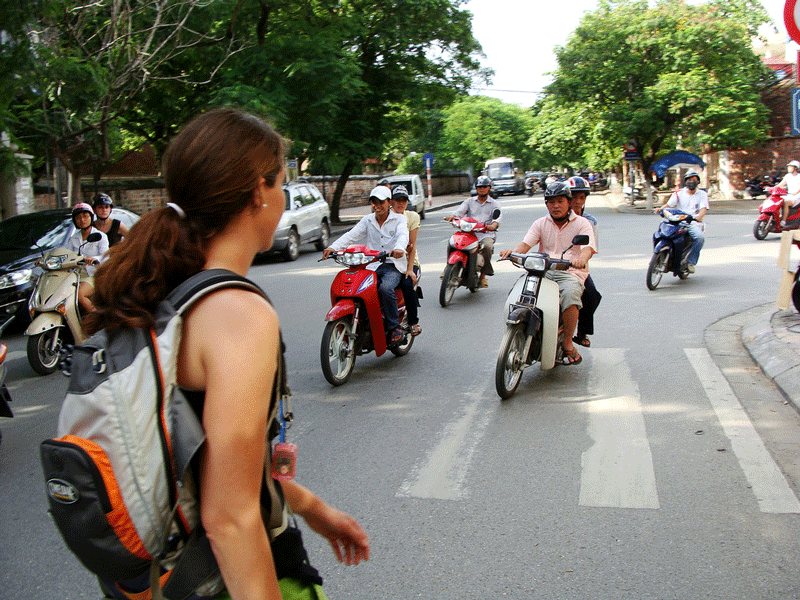
Crossing the road here is less about waiting for a gap and more about creating a predictable path. Here are the six golden rules to follow:
2.1 The “Local Shield” Strategy (Follow the Group)
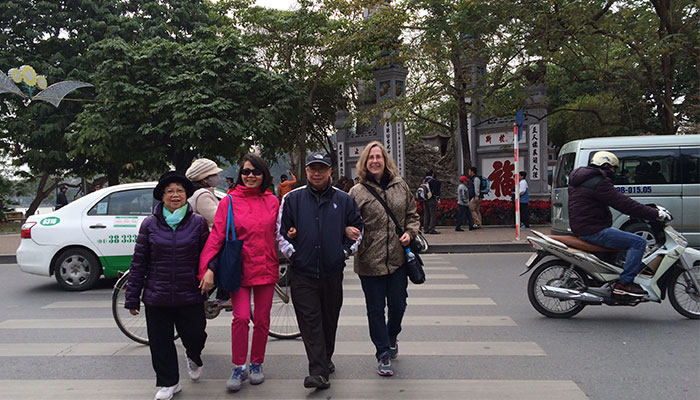
If you are feeling overwhelmed, the best way to cross is to wait for a group. Whether it’s a cluster of fellow tourists or a local grandmother carrying groceries, there is safety in numbers. A motorist might miss a single pedestrian, but they cannot ignore a wall of five people. By walking in a group, you increase your visual footprint, making it much easier for drivers to spot you from a distance.
2.2 Maintain a Slow, Steady, and Even Pace
This is the most critical NLP (Natural Language Processing) concept for pedestrians: Be Predictable.
-
The Technique: Once you start walking, do so at a constant, slow speed.
-
The Logic: Motorcyclists are constantly doing “predictive math.” They see where you are and where you will be in three seconds. If you maintain an even pace, they can easily steer into the space you just vacated. If you speed up or slow down, you “break” their calculation, which leads to near-misses.
2.3 The “No-Running” Rule
It is a natural instinct to see a gap and run for it. Do not do this. Running is an erratic movement. In a city like Hanoi, a driver might be coming from a blind spot or a side alley. If you bolt across the lane, they won’t have time to react. Firm, steady steps are your best defense.
2.4 Never Hesitate or Step Backward
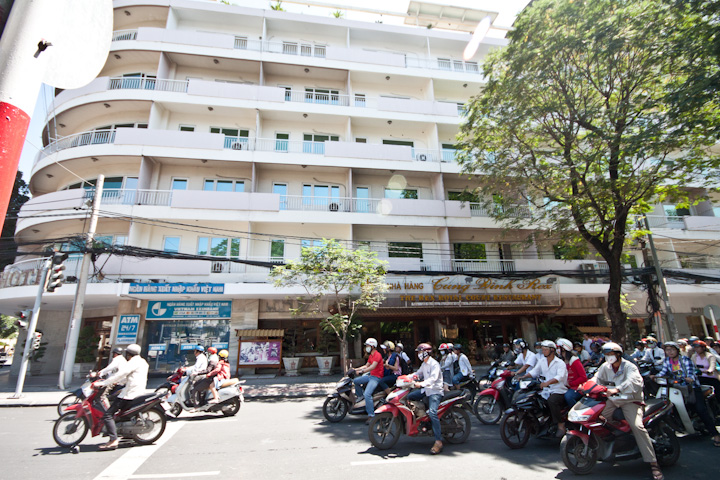
In Vietnamese traffic, the space behind you is considered “safe” for drivers. As you move forward, the motorbikes will naturally curve behind your heels.
-
The Danger: If you get scared halfway across and take a sudden step backward, you are stepping directly into the path of a motorbike that has already committed to passing behind you.
-
The Mantra: Commit to the crossing. Once you are in the flow, the only way out is forward.
2.5 Use the “Hand Signal”
While it may feel a bit assertive, raising your hand slightly in the direction of oncoming traffic is an excellent way to communicate. It tells the drivers: “I am here, I am moving, and I see you.” Usually, a palm held slightly out toward the motorbikes will cause them to give you a wider berth or slightly decrease their speed.
2.6 The 360-Degree Scan (Look Left, Right, and Everywhere)
Do not assume that because a street is marked “One Way,” traffic will only come from one direction. It is very common for locals to take shortcuts by driving against the flow for short distances.
-
Look Left: For the primary flow.
-
Look Right: For the “shortcut” drivers.
-
Look Up: For turning vehicles at intersections.
3. Summary of Travel Tips for First-Time Visitors
-
Avoid Eye-Gazing at Your Phone: Navigation is important, but keep your eyes on the road. Distracted walking is dangerous in a high-flow environment.
-
Don’t Close Your Eyes: It sounds funny, but some tourists literally close their eyes and walk. You need to be aware of the “rhythm” of the street.
-
Wear Bright Clothing: Especially at night, being visible helps motorcyclists calculate their path around you.
-
Trust the Flow: It feels counterintuitive, but the traffic wants to miss you. No one wants an accident. Trust that they see you.
4. How Golden Holiday Travel Ensures Your Safety?
Navigating Vietnam should be exciting, not terrifying. As a licensed tour operator, we prioritize the comfort of our guests.
-
Private Transfers: We provide private car rentals with professional drivers who understand the nuances of Hanoi traffic, ensuring you aren’t stuck navigating the most chaotic intersections on foot with heavy luggage.
-
Guided Walking Tours: Our local guides act as your “human shield,” teaching you the rhythm of the city while sharing the history of 36 ancient streets.
-
Expert Consultancy: Whether you are planning a 10-day Vietnam tour or just need advice on the best route from Hanoi to Ninh Binh, we are here to support you

Crossing the street in Hanoi is one of the most memorable parts of a Vietnam holiday. It is a lesson in mindfulness, confidence, and trust. Once you reach the other side of a busy street for the first time, you’ll feel a sense of accomplishment that no museum tour can replicate.
Ready for your Vietnam adventure? Let us help you navigate the beauty and the bustle of this incredible country. From private cars to fully customized itineraries, Golden Holiday Travel is your partner in safe, enjoyable travel by contacting us : [email protected] or WhatsApp: +84.988 45 15 30
We wish you a happy, safe, and exhilarating holiday in Vietnam
Frequently Asked Questions
The golden rule for crossing the street in Hanoi is to walk slowly and maintain a steady pace. Once you step off the curb, do not stop, run, or make sudden movements. Motorcyclists are experts at anticipating your trajectory and will flow around you like water around a stone. Keep your head up, make eye contact with oncoming riders if possible, and keep moving forward predictably.
The secret lies in predictability and confidence. Motorcyclists in Vietnam are constantly calculating the speed of pedestrians. If you hesitate or jump back, you disrupt their calculation. Think of the traffic as a school of fish; as long as you move at a constant, slow speed, the “school” will naturally divide and pass you on both sides without a collision.
In the Hanoi Old Quarter, traffic rarely comes to a complete stop, even at marked crosswalks. Waiting for a “gap” in the motorcycles can take a long time. Instead, wait for a slight lull, signal your intent by raising your hand slightly or making eye contact, and begin your slow, steady walk. Do not wait for the road to be empty, as this rarely happens during daylight hours.
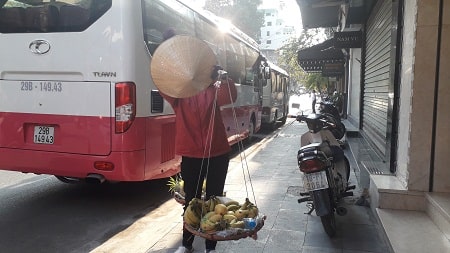
Yes, the “local shield” is a highly effective strategy for beginners. Wait for a local resident—such as a street vendor or someone clearly comfortable with the traffic—to begin crossing, and then walk closely alongside them on the side furthest from the traffic. This allows you to mirror their pace and use their experience to navigate the flow safely.
While traffic lights are generally followed at major intersections, you should still remain alert. Many motorcyclists may turn right on a red light or continue through a yellow. Zebra crossings do not guarantee that cars or bikes will stop for you. Always look both ways—even on one-way streets—as “wrong-way” driving is common for short distances.
Absolutely. As a licensed tour operator in Vietnam, Golden Holiday Travel prioritizes guest safety. Our professional guides often conduct a “street-crossing orientation” during the first hour of our Hanoi city tours. We ensure our guests feel confident navigating the Old Quarter and provide private transport to minimize stress in high-traffic areas, allowing you to enjoy the city’s vibrant energy safely.












Write Comment