
How to Cross the Street in Vietnam – A Comprehensive Guide for First-Time Travelers
How to cross the street in Vietnam is one of the most common questions foreign visitors ask when planning their trip to Vietnam. The constant stream of motorbikes and busy traffic can feel overwhelming when you first arrive in Vietnam.
With over 10 years of experience organizing customized Vietnam travel itineraries for travelers worldwide, our local experts at Golden Holiday Travel provide practical, firsthand traffic guide to help you understand Vietnam’s traffic culture and cross the streets safely. Learning how to cross the street like a local will give you the confidence to explore Vietnam safely and make the most of your holiday.
Is It Really Difficult to Cross the Street in Vietnam?
For many first-time visitors, crossing the street in Vietnam can feel intimidating, due to the constant flow of motorbikes and the country’s busy traffic. Unlike Western roads where traffic stops completely for pedestrians, traffic in Vietnam flows continuously, with drivers naturally steering around steady walkers. Understanding this rhythm helps visitors cross safely without fear or confusion.

Fully Licensed Local Agency
Vietnam Tour Packages – Tailor-Made & Private Customized Tours
Explore Vietnam with fully customized private tours, licensed local guides, and comfortable private cars. Our travel team creates personalized itineraries tailored to your pace, preferences, and budget.
Why First-Time Visitors Feel Overwhelmed?
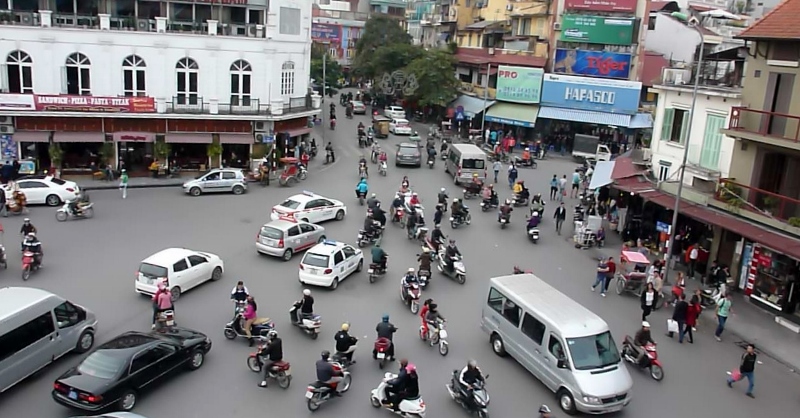
When arriving in major urban centers like Hanoi or Ho Chi Minh City, foreign tourists are confronted by a seemingly endless stream of vehicles. Vietnam has over 65 million registered motorbikes, with major metropolitan areas holding thousands of two-wheelers per square kilometer. During peak morning and evening hours, roads fill completely, creating a continuous wave of moving traffic.
First-time visitors often expect cars and scooters to stop at marked pedestrian crossings. When motorbikes continue moving past without stopping, travelers experience hesitation. Combined with horn sounds, engine noise, and busy sidewalk activities, walking onto a Vietnamese street requires a different mindset than you might be used to back home..
Is Vietnam’s Traffic Really Dangerous?
Although Vietnam’s streets may seem chaotic at first glance, traffic in most city centers usually moves at a relatively slow pace. Average vehicle speeds inside historic quarters and commercial districts hover between 20 km/h and 30 km/h. This moderate speed gives both drivers and pedestrians a few extra seconds to react, adjust, and safely share the road.
Accidents involving pedestrians in city centers are statistically less frequent than visitors fear. Vietnamese motorcyclists are highly aware of their surroundings because they’re constantly navigating through traffic. The real safety risk occurs when pedestrians make unpredictable movements, such as running, stopping abruptly mid-lane, or stepping backward into passing lanes.
Understanding the Local Traffic Culture
Traffic in Vietnam operates under unwritten rules established through decades of high-density commuting. Unlike strict rule-based traffic cultures, local road interactions rely heavily on real-time negotiations. Drivers constantly evaluate the movement of people and vehicles around them, adjusting their speed and direction within seconds
Honking in Vietnam carries a neutral, practical meaning rather than reflecting frustration or anger. A short tap on a motorbike horn simply alerts nearby walkers or drivers: “I am close to you” or “I am passing on your left.” Recognizing this friendly intent reduces anxiety and helps foreign travelers remain calm when walking near active traffic lanes.
Overview of Road Users in Vietnamese Cities
To assist foreign visitors in predicting driver behaviors, our local tour guides have compiled this comparative summary of urban road users in Vietnam:
| Vehicle Category | Average City Speed | Stoppage Probability | Typical Avoidance Behavior | Safe Pedestrian Strategy |
|---|---|---|---|---|
| Motorbikes & Scooters | 20 – 35 km/h | Very Low | Swerves smoothly around steady walkers | Walk steadily forward; allow them to steer behind you. |
| Cars & SUVs | 20 – 30 km/h | Low to Moderate | Slows down slightly; requires larger turning radius | Wait for clear gap; do not step closely in front of cars. |
| City Buses & Trucks | 15 – 25 km/h | Very Low | Maintains straight path; blind spots exist | Never attempt to cross in front; yield complete right of way. |
| Bicycles & Cyclos | 10 – 15 km/h | Moderate | Slows easily or steers past pedestrians | Maintain normal walking pace; keep visual contact. |
Why Traffic in Vietnam Looks Chaotic (But Actually Has a Pattern)?
To many first-time visitors, traffic in Vietnam may look chaotic, but it actually follows a surprisingly smooth system of shared understanding among road users. Drivers naturally adjust their speed and direction based on where they expect pedestrians and other vehicles to move, rather than strictly following lane markings. Understanding how motorbike riders judge distance helps pedestrians move safely and confidently through Vietnam’s busy streets.
The Dominance of Motorbikes
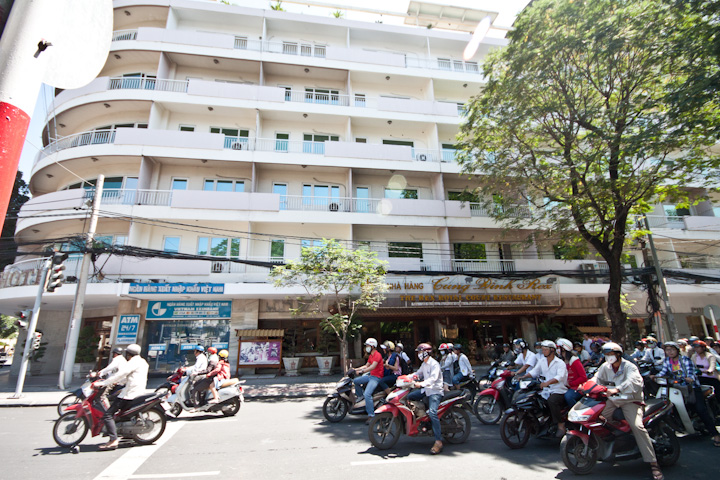
Motorbikes account for over 85% of personal transportation in major cities. Because two-wheelers are narrow, flexible, and responsive, they do not travel in strict single lanes. Instead, they fill available street surface area efficiently, passing on both left and right sides of larger vehicles.
This flexibility means motorbike riders expect obstacles on the road, including street sweepers vendors, and pedestrians. Rather than viewing a walking person as a complete obstacle, a rider simply view him/her to keep moving at a steady, predictable pace.
Why Drivers Rarely Come to a Complete Stop?
In Vietnam’s busy cities, traffic moves as a continuous flow. If every motorbike came to a complete stop for each pedestrian crossing the road, the traffic behind would quickly back up, increasing the risk of rear-end collisions and creating congestion. Instead, riders usually slow down and carefully steer around pedestrians, while pedestrians maintain a steady, predictable pace so everyone can move safely.
As a result, most Vietnamese riders try to keep moving whenever possible. Instead of stopping completely, they usually slow down to around 10–15 km/h and gently steer around pedestrians. This steady flow of traffic allows people to cross safely – as long as they walk at a consistent pace
How Local Drivers Predict Pedestrian Movement?
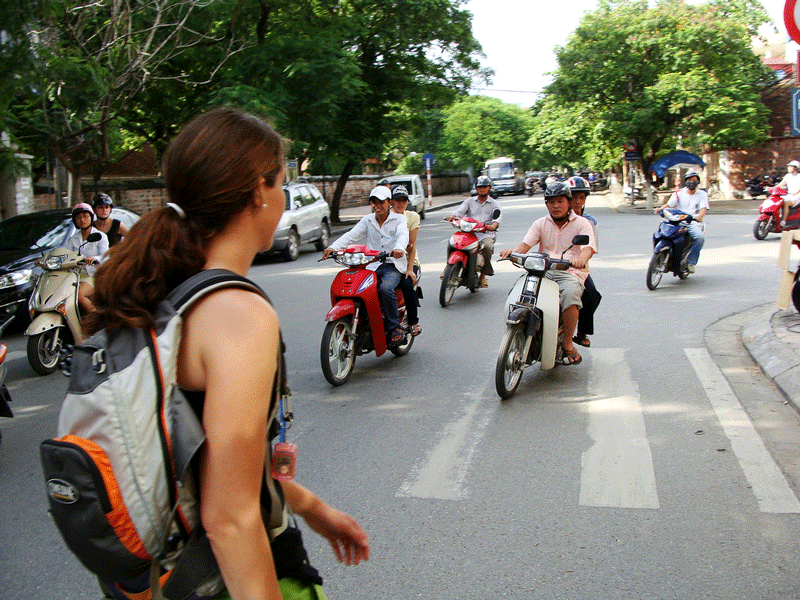
As you step onto the road, approaching riders analyze your walking direction, speed, and body orientation. They calculate where your feet will land over the next two to three seconds. Based on that mental calculation, the rider adjusts their handlebar position by a few degrees to pass behind your current position.
This predictive math works reliably as long as you maintain your speed. If you suddenly stop, jump forward, or step back, it becomes much harder for them to predict your next move, forcing them to brake or quickly steer around you. Predictability is the true secret to safe road crossings in Vietnam.

Fully Licensed Local Agency
Northern Vietnam Tours & Private Excursions
Discover Northern Vietnam comfortably with our private car services, dedicated tour guides, and tailor-made travel packages covering Hanoi, Halong Bay, Sapa, and Ninh Binh.
Step-by-Step Guide to Crossing the Street Safely in Vietnam
If you’re visiting Vietnam for the first time, crossing the street can feel like a challenge. The good news is that there’s a simple technique locals use every day. Stay calm, walk steadily, and make your movements predictable so drivers can anticipate your path. With a little practice, you’ll quickly gain the confidence to navigate even the busiest streets.
Step 1: Choose the Safest Crossing Point
Before stepping onto the road, select a location with high sight visibility. Look for designated zebra crossings or signalized intersections whenever available. Avoid stepping out from directly behind large parked buses, delivery trucks, or temporary street stalls that obscure approaching drivers’ sightlines.
Position yourself where approaching motorbikes can see you from at least 30 meters away. Straight road sections offer better visibility than sharp corners or multi-way alley entrances where vehicles turn abruptly.
Step 2: Wait for a Suitable Gap
Pause briefly at the curb edge to assess the oncoming traffic stream. Do not wait for roads to clear completely, as continuous traffic flow in major cities like Hanoi means empty streets rarely occur during daytime hours.
Instead, look for a relative gap in heavy vehicle traffic such as a small distance between large trucks or cars and prepare to enter the motorbike stream with confidence.
Step 3: Walk Slowly at a Steady Pace
Step off the pavement smoothly and begin walking across at a calm, consistent speed. Keep walking at a steady pace so drivers can easily predict where you’re heading.
Never rush or make sudden movements. Walk at a slow, steady pace instead. Vietnamese drivers are used to predicting pedestrians’ movements, and they’ll naturally steer around you as long as you remain calm and keep a consistent pace.
Step 4: Maintain Eye Contact with Drivers
As you step across each traffic lane, turn your head slightly toward approaching vehicles. Look directly toward oncoming motorcyclists. Making eye contact confirms to the driver that you are aware of their presence.
Along with eye contact, you can extend your arm slightly forward with your palm facing oncoming traffic. This non-verbal hand signal communicates your crossing intention politely and clearly encourages riders to yield space.
Step 5: Never Run or Suddenly Change Direction
The golden rule when crossing the street in Vietnam is simple: keep moving forward at a steady pace. Never run across lanes, even if you see an open space ahead. Running across the street can actually make things more dangerous, as motorbike riders may not have enough time to adjust when your speed or direction suddenly changes.
Likewise, avoid stepping backward or suddenly stopping in the middle of the road. Motorbike riders are usually reading your movement and adjusting their direction to pass behind you. The safest approach is to stay calm, keep a steady pace, and continue walking forward until you reach the other side safely..
Safe vs. Unsafe Pedestrian Actions in Vietnam
To summarize the essential walking habits, review this simple action comparison prepared by our local travel team:
| Pedestrian Action | Risk Level | Impact on Driver Reaction | Recommended Action |
|---|---|---|---|
| Walking steadily at constant speed | Low Risk | Drivers calculate path easily and pass behind | Maintain steady, predictable forward pacing. |
| Running across lanes/ roads | High Risk | Causes hard braking and sudden lane changes | Never run; keep steps smooth and controlled. |
| Stepping backward mid-street | High Risk | Steps directly into the path of approaching motorbikes | Commit to moving forward; never step back. |
| Hold your arm out with an open hand to signal drivers | Low Risk | Alerts oncoming riders to give extra space | Use gentle hand signals while looking ahead. |
| Looking down at mobile phone | High Risk | Prevents eye contact and situational awareness | Put mobile devices away before stepping off curb. |
Where Is the Safest Place to Cross the Street?
Identifying optimal pedestrian crossing locations reduces the complexity of dealing with dense traffic in Vietnamese cities. While Vietnam has pedestrian crossings, traffic lights, and overpasses, understanding how local drivers respond to these facilities helps travelers choose safer and more comfortable ways to cross the road
Zebra Crossings
Zebra crossings mark official areas where pedestrians are allowed to cross the road. However, first-time visitors should keep in mind that in Vietnam, drivers do not always stop automatically at zebra crossings, especially those located in the middle of a street.
Treat zebra lines as preferred crossing paths where drivers expect pedestrian presence. Enter the crosswalk calmly using proper eye contact and steady steps rather than assuming vehicles will come to a complete stop before you step out.
Traffic Lights
Major intersections in central urban zones feature traffic signals equipped with pedestrian countdown timers and green walking lights. Crossing when the traffic light is green gives you a safer, more predictable window as vehicles from other directions are stopped.
Even when walking during a green light, stay alert for motorbikes turning right on red, which is permitted at many intersections in Vietnam. Always check left and right for turning vehicles before stepping across signalized junctions.
Pedestrian Overpasses and Underpasses
Modern urban developments and major arterial avenues in cities like Hanoi and Ho Chi Minh City feature elevated pedestrian bridges and underground walkways. These structures offer complete protection from road traffic.
Whenever elevated overpasses or subway tunnels are available near busy boulevards or hospital zones, take advantage of these facilities for 100% vehicle-free road crossings.
Following Local Pedestrians
Traffic Differences Between Major Cities in Vietnam
Traffic conditions and driving habits vary significantly across Vietnam’s different regions and cities. Understanding the subtle differences between northern capitals, southern commercial hubs, and coastal tourist towns helps travelers adapt their street-crossing habits accordingly.
Crossing the Street in Hanoi
Hanoi’s Old Quarter features narrow, historical streets packed with motorbikes, sidewalk cafes, and outdoor merchandise displays. Because lanes are compact, vehicle speeds remain relatively low (15 to 25 km/h).
Crossing roads in Hanoi requires short, precise steps. Keep an eye out for motorbikes coming from narrow alleyways (ngõ), and walk at a steady, predictable pace when crossing small intersections around Hoan Kiem Lake.
Crossing the Street in Ho Chi Minh City
Ho Chi Minh City (Saigon) features wide multi-lane boulevards, long avenues, and higher overall vehicle speeds (30 to 45 km/h). Motorbikes move in dense waves alongside higher numbers of private cars, taxis, and public buses.
When crossing avenues in District 1 or District 3, wait for larger gaps in car traffic and make extensive use of pedestrian traffic signals and overpasses where available.
Smaller Cities and Tourist Destinations
In smaller provincial capitals and tourist centers such as Hoi An, Hue, Sapa, or Ninh Binh, traffic volume is significantly lighter. Hoi An’s Ancient Town enforces pedestrian-only hours during daytime and evening periods, prohibiting motorized vehicles completely.
Safety Tips for Families, Seniors, and Solo Travelers
Different types of travelers may need different approaches when navigating Vietnam’s busy streets and traffic conditions. Applying targeted safety measures ensures that family groups with young children, elderly visitors, and solo travelers move across streets comfortably and without incident.
Crossing with Children
Parents traveling with children should maintain physical hand contact at all times near roads. Hold your child’s hand firmly and position yourself on the side facing oncoming vehicle traffic.
Explain the steady walking rule to young children beforehand: emphasize that they must walk attached to adults without running or stopping abruptly mid-street.
Advice for Elderly Travelers
For senior travelers who may walk more slowly, it is best to choose safer crossing points such as areas with traffic lights, pedestrian crossings, or overhead bridges. If you need to cross a road without signals, try to follow the pace of local pedestrians or ask hotel staff, tour guides for help when needed.
Safety Tips at Night or During Rain
Reduced visibility at night or during heavy monsoon rain showers requires extra caution. Wear brightly colored clothing or reflective elements during evening walks. During rainstorms, motorbikes require longer stopping distances; allow extra distance before stepping onto wet pavement.
What to Do If You Feel Too Nervous to Cross?
Feeling overwhelmed by dense traffic is completely normal for first-time visitors to Vietnam. When anxiety strikes near a busy street, simple practical alternatives allow travelers to cross safely without experiencing unnecessary stress.
Ask a Local for Help
Vietnamese citizens are hospitable and accustomed to assisting foreign visitors. If you feel hesitant at a busy curb, signal politely to a nearby security guard, restaurant host, or shopkeeper. They will gladly walk beside you across the road.
Walk Together with a Group
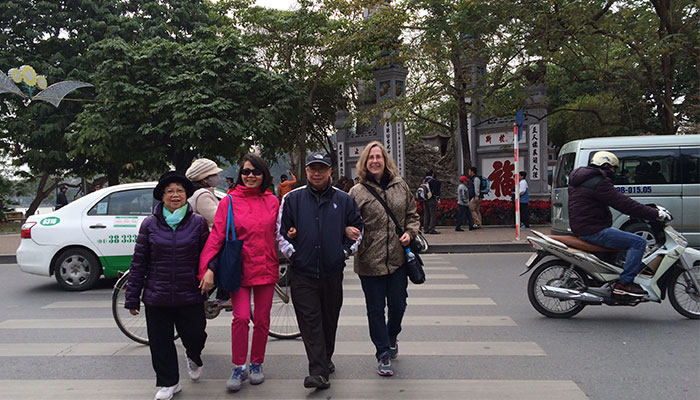
Wait at the sidewalk edge until other commuters or foreign tour groups accumulate. Joining a larger cluster of pedestrians creates a substantial visual footprint that forces oncoming motorbikes to adjust their paths widely around the group.
Use Traffic Lights Whenever Possible
Walking an extra 50 or 100 meters down a block to cross at a signalized intersection provides peace of mind. Taking a short detour to find green light signals removes personal stress and ensures organized road passage.
Common Mistakes Tourists Make When Crossing Vietnamese Streets & Our Tips for Crossing the Street with Confidence
First-time travelers frequently fall into predictable traffic mistakes due to habits learned in home countries. Correcting these common missteps allows visitors to move through Vietnamese urban centers smoothly and safely.
Frequent Tourist Mistakes to Avoid:
- Running Across the Road: Rushing creates unpredictable targets for motorists making split-second steering decisions.
- Stopping Suddenly in the Middle: Freezing in the center of a lane disrupts the flow of motorbikes aiming to pass behind your position.
- Looking Only One Direction: Assuming one-way streets have single-direction traffic leads to surprises from delivery drivers taking short routes.
- Crossing While Distracted by Your Phone: Looking at map applications while stepping off the curb prevents essential eye contact with approaching drivers.
- Assuming Vehicles Will Always Stop: Expecting cars or motorbikes to halt completely at painted lines without visual engagement increases safety risks.
Expert Corrective Tips from Our Local Team:
- Stay Calm and Walk at a Consistent Pace: Take a deep breath before stepping off the curb, keep your eyes on oncoming traffic, and maintain a steady rhythm across all lanes.
- Trust the Flow—but Stay Alert: Understand that local drivers actively work to avoid pedestrians, but remain fully aware of larger vehicles like trucks and city buses that need longer stopping distances.
- Enjoy Vietnam Like a Local: Treat street crossing as an authentic cultural experience that connects you with the energetic daily cadence of Vietnamese life.

Fully Licensed Local Agency
Vietnam Adventure Tours & Off-the-Beaten-Track Excursions
Experience active adventures across Vietnam with private transfers, experienced local guides, and custom travel packages designed around your personal travel style.
Hotline Booking: +84.988451530 (WhatsApp)
Frequently Asked Questions (FAQs) About Crossing the Street in Vietnam
Q1: Is it safe to cross the street in Vietnam as a foreign tourist?
Yes, crossing streets in Vietnam is safe when following basic local practices. Walk steadily, keep a predictable pace, and maintain eye contact with approaching drivers. Motorcyclists calculate your walking line and steer around you smoothly. Avoid sudden movements or running across lanes.
Q2: Do vehicles in Vietnam yield to pedestrians at zebra crosswalks?
Vehicles rarely come to a complete halt at unmarked zebra crosswalks in Vietnam. Zebra lines indicate crossing zones, but pedestrians must still step out carefully and walk steadily. Approach with confidence while watching oncoming traffic closely.
Q3: What should I do if traffic feels too heavy to cross alone?
Wait at the curb until local residents or a group of travelers cross, then walk beside them. Alternatively, seek assistance from nearby security personnel or shopkeepers, who are happy to guide foreign visitors across busy streets safely.
Q4: Is traffic different between Hanoi and Ho Chi Minh City?
Yes. Hanoi streets are narrower with slower vehicle speeds, making street crossing manageable. Ho Chi Minh City features wider multi-lane avenues with faster car and motorbike traffic, requiring greater care and reliance on signalized intersections.
Q5: Should I use hand signals when crossing roads in Vietnam?
Yes. Raising your hand slightly with an open palm facing traffic communicates your intention to drivers. This gentle visual signal alerts approaching motorcyclists to give you sufficient clearance as you cross.

Plan Your Dream Vietnam Trip with Our Travel Expert
Mastering how to cross the street in Vietnam is an essential part of enjoying your holiday in Hanoi or Ho Chi Minh City. Our local team at Golden Holiday Travel offers custom Vietnam Tour Package arrangements, including private car rentals with professional drivers and local tour guides to keep your travels completely comfortable. Plan your tailor-made itinerary today by messaging our team on WhatsApp +84.988451530 or emailing [email protected] for immediate trip support.
Note: The travel tips and recommendations shared in this guide have been carefully prepared by the local travel experts at Golden Holiday Travel. While every traveler is different, our team is always happy to provide personalized itinerary planning, destination advice, and one-on-one support to help you create the perfect Vietnam journey.

Meet Our Experts

Suggested


Featured article


Related Articles




Write Comment