
Discover Cao Bang: 10 Must-See Places for Nature & Adventure Lovers
Places to visit in Cao Bang offer travelers a chance to explore a spectacular border province filled with limestone mountains, cascading waterfalls, impressive caves, and traditional ethnic villages. Located around 300 kilometers north of Hanoi near the Chinese border, Cao Bang is a peaceful escape from Vietnam’s busier tourist routes. Because many attractions are scattered across remote mountain roads, it’s worth planning ahead and checking local road conditions, seasonal weather, travel times, and the highlights along your route.
With 10+ years of experience operating private Vietnam tours for travelers worldwide, our local travel experts at Golden Holiday Travel have helped thousands of them explore the region safely and authentically. As a fully licensed tour operator, we share practical travel information & tips to help you discover the best places in Cao Bang.
Key Takeaways for Your Cao Bang Trip:
- Top Natural Attractions: Witness the thundering multi-tiered cascades at Ban Gioc Waterfall, walk through the massive limestone chambers of Nguom Ngao Cave, and explore the tranquil emerald waters of Thang Hen Lake.
- Cultural & Historical Highlights: Visit the historic Pac Bo stream and cave complex where President Ho Chi Minh stayed in 1941, and spend time in traditional Nung and Tay handicraft villages such as Phia Thap and Pac Rang.
- Scenic Mountain Drives: Drive across dramatic winding passes including Ma Phuc Pass and the 14-tier Me Pia Pass within the Non Nuoc Cao Bang UNESCO Global Geopark.
- Practical Travel Logistics: Allocate at least 3 to 4 days from Hanoi to explore Cao Bang at a comfortable pace, ideally by private vehicle with an experienced mountain driver.
Why Cao Bang Should Be on Your Vietnam Travel List?
Cao Bang delivers a rare combination of unspoiled karst geology, national historical landmarks, and tranquil rural valleys where ethnic minority traditions thrive. Unlike heavily commercialized mountain towns, this northern border province maintains an unhurried daily rhythm, allowing travelers to enjoy vast natural landscapes without long queues or crowded viewpoints.

Fully Licensed Local Agency
Northern Vietnam Tours & Private Mountain Excursions
Discover Cao Bang and the Northeast region with private air-conditioned transport, licensed English-speaking local guides, handpicked boutique stays, and personalized schedules tailored to your travel style.
What Makes Cao Bang Different from Other Northern Vietnam Destinations?
While Sapa is famous for steep terraced rice valleys and Ha Giang is recognized for towering bare limestone peaks, Cao Bang stands out with its green conical karst hills, wide river valleys, and underground river systems. The landscape here is softer and greener, characterized by the crystal-clear Quay Son River meandering past fields of golden rice, bamboo waterwheels, and traditional Tay and Nung stilt house villages.
Tourism infrastructure in Cao Bang has developed at a moderate pace, preserving the authentic feel of rural villages. You can spend full days exploring expansive cave networks and waterfalls while encountering only a modest number of fellow travelers, which provides an authentic atmosphere for landscape photography and cultural interactions.
How Many Days Do You Need in Cao Bang?
Because Cao Bang is situated approximately 6 to 7 hours of driving time from Hanoi, a minimum stay of 3 days and 2 nights is necessary to see the core highlights such as Ban Gioc Waterfall, Nguom Ngao Cave, and Pac Bo Historical Site. A 3-day itinerary allows you to travel comfortably from Hanoi, spend a full day in the eastern districts of Trung Khanh and Quang Uyen, and visit the historic northern valley before returning.
For travelers who prefer a slower pace with time for light trekking, visiting traditional blacksmithing villages, and cycling through tranquil valleys, a 4-day or 5-day itinerary is recommended. Combining Cao Bang with Ba Be Lake in neighboring Bac Kan province or extending across to Ha Giang creates a comprehensive 6 to 8-day overland circuit across the Northeast mountains.
When Is the Best Time to Visit Cao Bang?
Cao Bang experiences four distinct seasons, each offering a different perspective on its natural scenery. The ideal travel window falls between September and October, when autumn brings clear blue skies, comfortable temperatures ranging from 20°C to 28°C, and golden ripening rice fields along the Quay Son River.
During the winter months from November through February, temperatures can drop below 10°C in the high mountain passes, often accompanied by morning mist that gives the limestone peaks an ethereal appearance. Spring from March to May brings blooming wild flowers and pleasant walking weather, while the summer months from June to August feature higher water volume at Ban Gioc Waterfall alongside occasional heavy tropical rainfall.
| Travel Style | Recommended Duration | Key Sights Covered | Ideal For |
|---|---|---|---|
| Express Highlights | 3 Days / 2 Nights | Ban Gioc Waterfall, Nguom Ngao Cave, Truc Lam Pagoda, Pac Bo | First-time visitors with limited vacation time |
| Cultural & Scenic Loop | 4 Days / 3 Nights | Ban Gioc, Nguom Ngao, Thang Hen Lake, Phia Thap, Pac Rang, Pac Bo | Couples, families, and cultural enthusiasts |
| Northeast Grand Circuit | 6 to 8 Days | Ba Be Lake, Cao Bang highlights, Me Pia Pass, Bao Lac, Dong Van Karst Plateau | Adventure lovers and landscape photographers |
Top 10 Incredible Places to Visit in Cao Bang
To help you build a well-organized travel schedule, our team has curated the 10 most notable places to visit in Cao Bang based on landscape quality, historical importance, and cultural depth. These destinations showcase the full diversity of the province, from grand natural water systems to peaceful mountain communities.
1. Ban Gioc Waterfall – Cao Bang’s Most Iconic Natural Wonder
Ban Gioc Waterfall serves as the crown jewel of Cao Bang province and stands among the most impressive border waterfalls in Asia. Located in Dam Thuy commune, Trung Khanh district, approximately 85 kilometers from Cao Bang city, the waterfall spans over 300 meters in width and drops across multiple limestone tiers into the serene Quay Son River.
Visitors can take a traditional bamboo raft ride directly onto the river basin to feel the refreshing mist and observe the sheer force of the cascading water up close. The surrounding banks are lined with weeping willows, bamboo groves, and lush green pastures where local water buffalo graze peacefully.
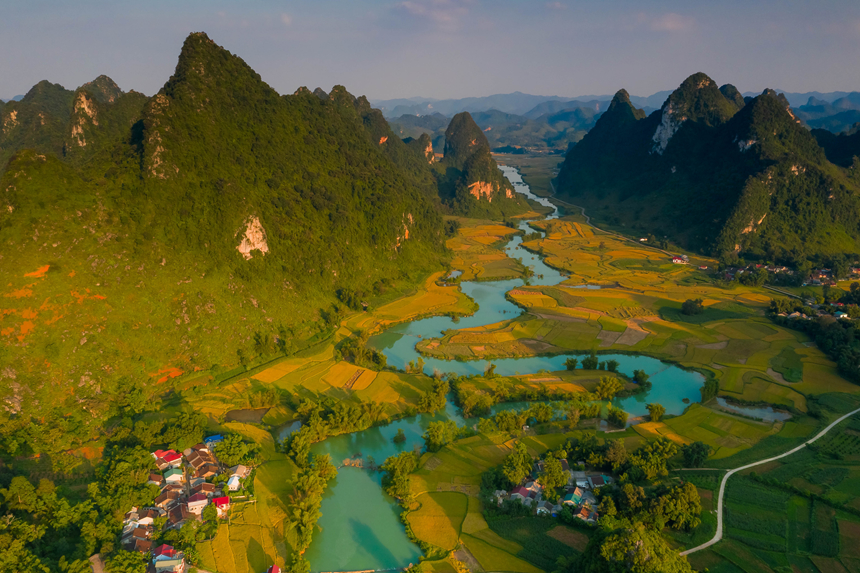
Quay Son river and dramatic limestone mountainscapes in Trung Khanh district
2. Nguom Ngao Cave – A Fascinating Underground World
Located only 3 kilometers from Ban Gioc Waterfall in Gun village, Nguom Ngao Cave is an enormous limestone cavern extending over 2,100 meters through the heart of a mountain. The name translates to Tiger Cave in the local Tay language, rooted in ancient folklore of wild tigers sheltering in the cavern chambers.
The public walking route covers roughly one kilometer of well-lit concrete paths and wooden staircases. Inside, you will encounter spectacular geological formations including the famous inverted lotus flower stalactite, towering stone pillars, and subterranean streams flowing through ancient rock corridors.
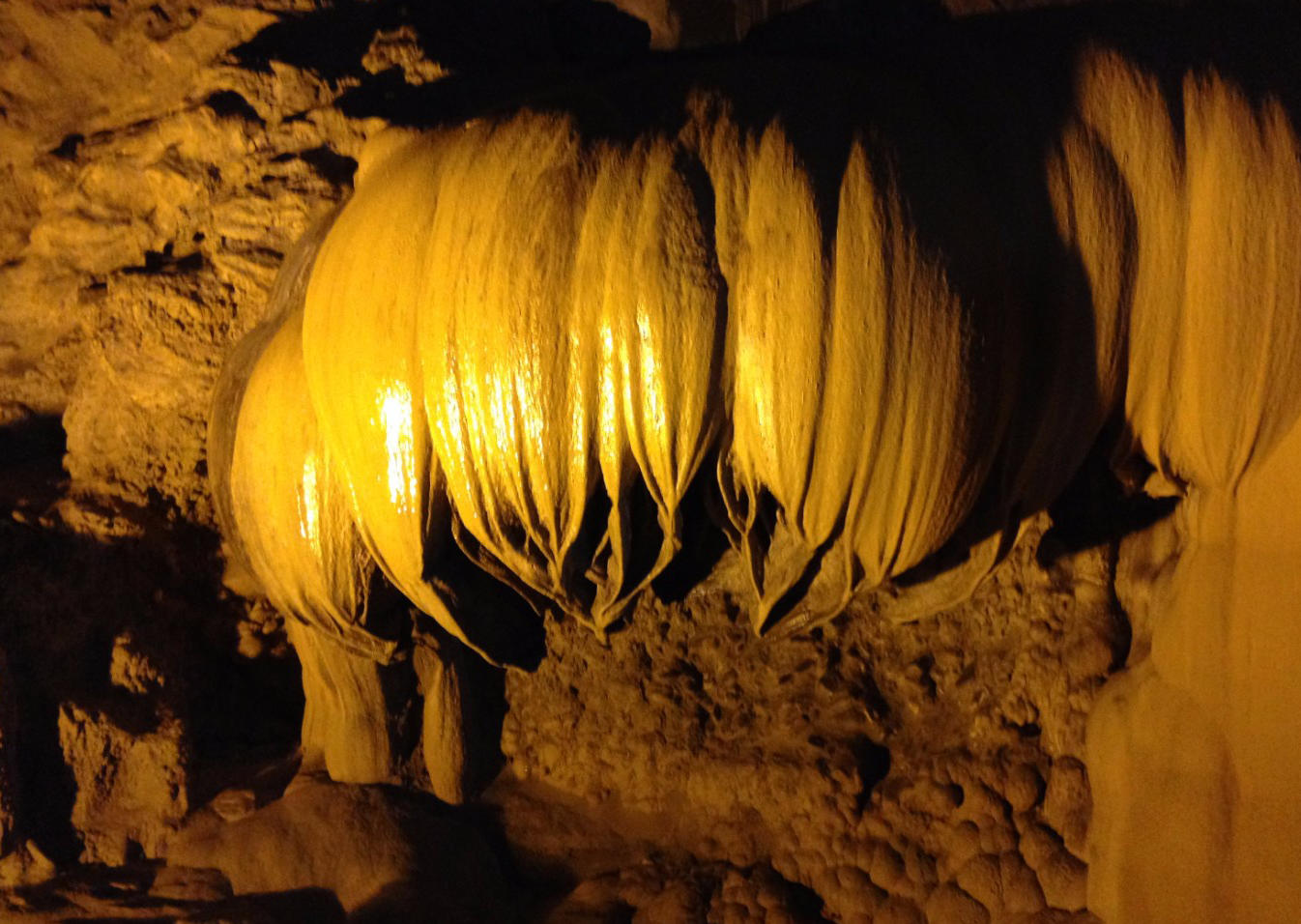
Intricate stalactite and stalagmite formations inside Nguom Ngao Cave
3. Phat Tich Truc Lam Ban Gioc Pagoda – Mountain Views with a Spiritual Touch
Perched on the northern slope of Phia Nham mountain, Phat Tich Truc Lam Ban Gioc Pagoda is the first Buddhist monastery constructed in this northern frontier region. Built in traditional Vietnamese wooden architecture with curved tiled roofs, the complex includes a grand triple gate, an ornate bell tower, and serene shrine halls dedicated to national heroes and Buddhist teachings.
A gentle climb up the stone staircases leads to an elevated viewing courtyard that offers an uninterrupted panoramic view across the entire Dam Thuy valley. From this vantage point, you can photograph Ban Gioc Waterfall cascading in the distance against a backdrop of tiered mountain ridges.
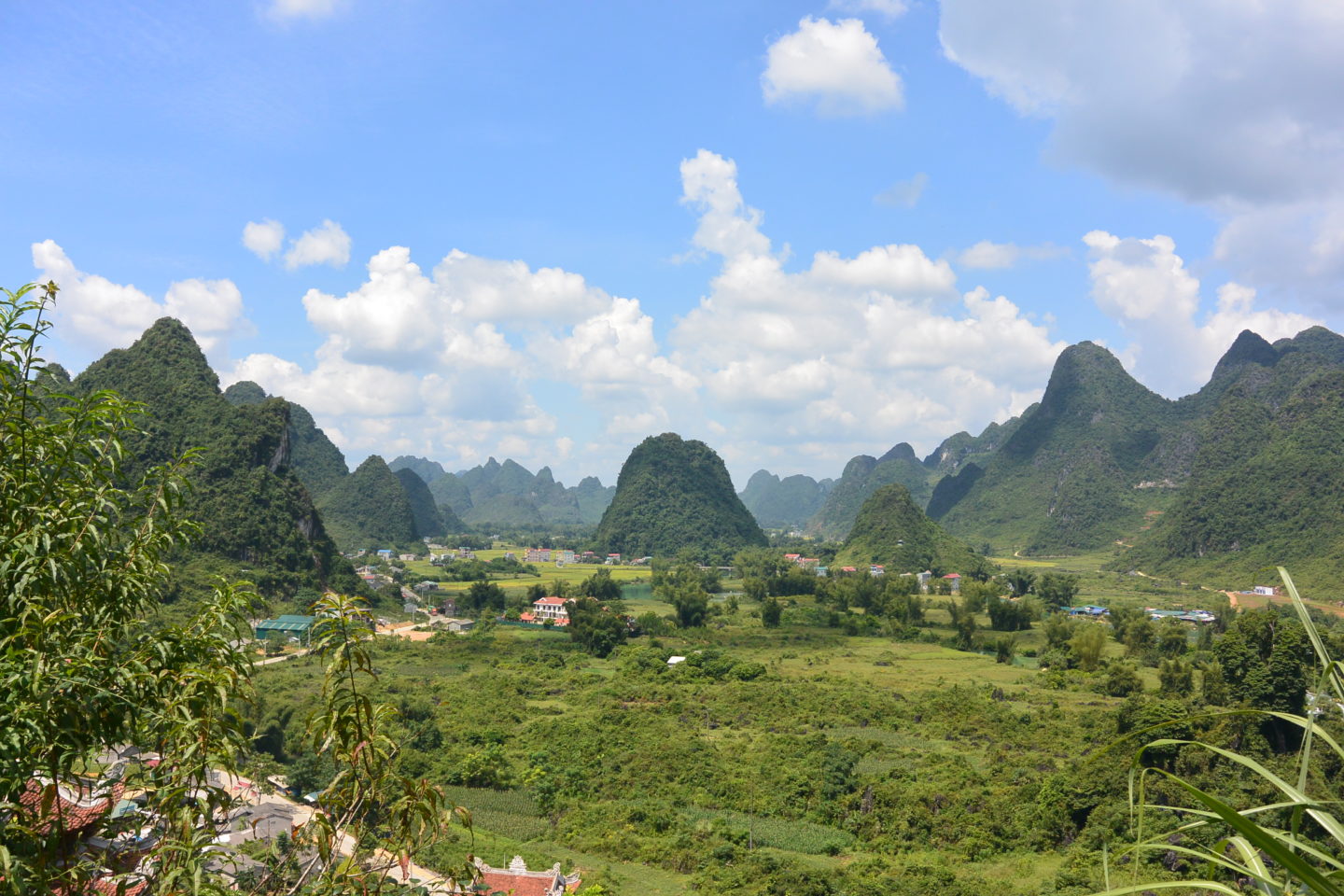
The elevated panoramic view overlooking the valley from Truc Lam Ban Gioc Pagoda
4. Ma Phuc Pass – A Scenic Gateway into Cao Bang
Ma Phuc Pass is widely regarded as one of the most scenic mountain passes in Northeast Vietnam, situated along National Highway 3 between Cao Bang city and the eastern border districts. The pass features seven sweeping hairpin turns winding up the limestone slope, flanked by two towering rock formations that resemble two kneeling horses facing each other.
As an official geological heritage site of the Non Nuoc Geopark, Ma Phuc Pass displays ancient pillow basalt lavas formed over 260 million years ago under prehistoric oceans. Pulling over at safe roadside viewpoints allows travelers to take in views of patchwork corn and rice fields spreading across the valley below.
5. Trung Khanh – Discover Cao Bang’s Peaceful Countryside
Trung Khanh district serves as the agricultural heartland of eastern Cao Bang, renowned for its fertile river plains, tranquil rural hamlets, and expansive chestnut orchards. The Quay Son River winds gently through the center of the district, supplying clean mountain water to vast paddy fields and spinning bamboo waterwheels that have operated for generations.
Spending an afternoon cycling or walking along the rural village lanes in Trung Khanh provides an intimate look at the daily routines of Tay farmers tending their crops and children walking home from school. In autumn, local markets fill with fresh roasted Trung Khanh chestnuts, a regional specialty known for their rich, sweet flavor.
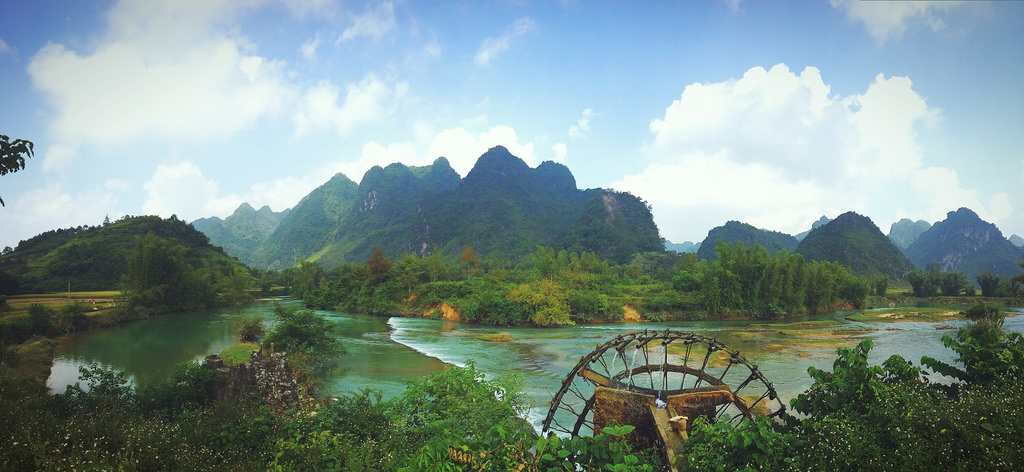
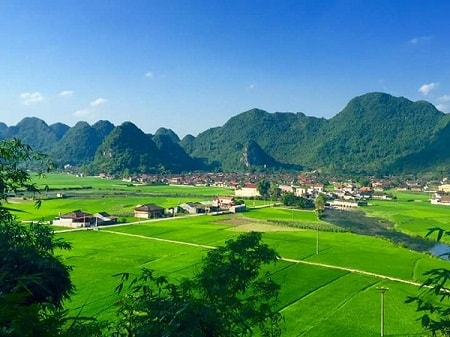
Peaceful rural countryside and conical karst hills in Trung Khanh district
6. Thang Hen Lake – A Peaceful Alpine Escape
Situated in Quoc Toan commune, Tra Linh district, approximately 30 kilometers north of Cao Bang city, Thang Hen Lake is a serene alpine body of water nestled inside a closed karst valley at an altitude of roughly 1,000 meters above sea level. Thang Hen is the largest of a system of 36 interconnected mountain lakes connected by underground cavern channels.
During the rainy season, the water levels rise and merge the individual lake basins into a singular body of emerald-green water surrounded by dense jungle vegetation. Visitors can rent a quiet wooden rowboat to glide along the tranquil waters, listening to birdsong echoing off the steep limestone cliffs.

The tranquil emerald waters of Thang Hen Lake surrounded by karst peaks
7. Pac Bo Historical Site – Where History Meets Nature
Pac Bo Historical Complex in Ha Quang district holds immense national significance as the secret revolutionary base chosen by President Ho Chi Minh upon returning to Vietnam in February 1941 after thirty years of living and traveling abroad. The site is located 52 kilometers north of Cao Bang city, just a short walk from the international border marker.
Beyond its profound historical background, Pac Bo is renowned for its natural setting. The turquoise waters of Lenin Stream flow past moss-covered boulders, shaded by dense mountain canopy and framed by Karl Marx Mountain. Visitors can walk along the shaded stone pathway to view Coc Bo Cave, the rustic wooden bed, and the natural stone table where historic strategies were formulated.
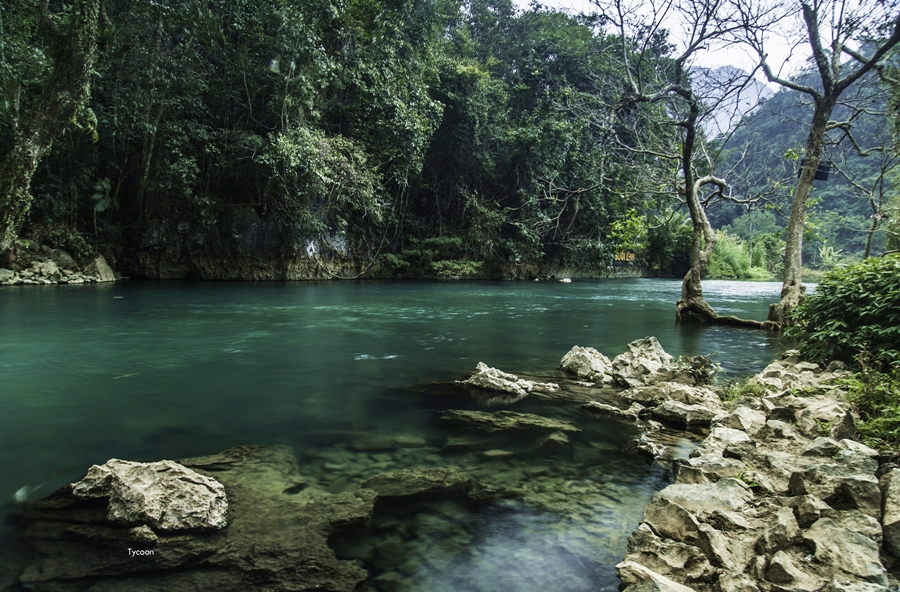
The clear turquoise waters of Lenin Stream at the Pac Bo Historical Complex
8. Me Pia Pass – The Legendary 14-Tier Mountain Road
Me Pia Pass, located along National Highway 4A connecting Xuan Truong commune to Bao Lac district, represents one of the most daring highway engineering achievements in Vietnam. The road winds steeply up the mountainside, twisting through 14 tight hairpin bends that form a striking zigzag across the rugged limestone slopes.
While driving across the pass requires strict attention from professional mountain drivers, active travelers can hike a 45-minute forest trail to a high mountain viewpoint. Looking down from the summit reveals the complete 14-storey switchback road descending into the forested valley below.
9. Non Nuoc Cao Bang – a UNESCO Globlal Geopark
Covering an area of more than 3,000 square kilometers across nine districts, Non Nuoc Cao Bang was officially designated as a UNESCO Global Geopark in 2018. The geopark preserves over 500 million years of Earth history through fossil deposits, marine sediments, karst sinkholes, and distinct peak-cluster limestone towers.
Exploring the geopark allows visitors to appreciate the direct harmony between ancient geology and indigenous ethnic culture. The park is home to more than nine distinct ethnic minority groups, including the Tay, Nung, Dao, Hmong, and San Chi, each preserving unique architectural styles, oral traditions, and agricultural practices.

Limestone towers and river plains across the Non Nuoc Cao Bang UNESCO Global Geopark
10. Khuoi Khon Village & Traditional Craft Communities
For an in-depth cultural immersion, visiting traditional craft villages in Cao Bang provides meaningful insight into local artisan heritage. Located in Quang Uyen district, Phia Thap village is home to Nung An families who have handcrafted herbal incense sticks for generations using natural bark, sawdust, and leaves dried under the open sky.
Nearby, Pac Rang village preserves an age-old blacksmithing tradition where master metalworkers hand-forge agricultural tools, knives, and scissors over open charcoal hearths. Further west in Bao Lac district, Khuoi Khon village offers a rare opportunity to meet the Black Lo Lo ethnic group, known for their elaborate hand-embroidered clothing and traditional timber stilt architecture.

Nung An artisan making traditional herbal incense sticks in Phia Thap village
Fully Licensed Local Agency
Customized Vietnam Adventure Tours & Multi-Day Treks
Experience off-the-beaten-path mountain trails, remote ethnic homestays, and majestic highland passes with 24/7 dedicated support from our local operational team.
Common Mistakes & Our Practical Tips for Visiting Cao Bang
Navigating the remote mountainous topography of Cao Bang presents specific logistical considerations that differ from urban touring. Based on our team’s regular field inspections and driver reports, we have outlined the most frequent traveler pitfalls and our professional advice for a seamless journey.
- Underestimating Driving Times on Mountain Passes: Many visitors assume a 100-kilometer distance in Cao Bang takes 90 minutes. In reality, steep gradients, tight curves, and rural farm traffic reduce average speeds to 35-45 km/h. Our Advice: Limit daily travel to two major sightseeing zones and allow generous buffer time for photography stops and scenic rest breaks.
- Traveling During Summer Storms Without Local Updates: Tropical storm systems between June and August can trigger heavy downpours that cause temporary rockfalls on mountain corridors. Our Advice: Verify localized weather forecasts 48 hours prior to departure and travel with experienced drivers who understand safe mountain route alternatives.
- Failing to Respect Cultural Cultures in Remote Villages: Entering traditional stilt homes or taking close-up portraits without asking can cause discomfort among ethnic elders. Our Advice: Always ask your local guide to request permission before entering family living spaces or photographing craft artisans at work.
- Relying on Public Buses Between Dispersed Sights: Public buses connect Hanoi to Cao Bang city, but attractions like Ban Gioc Waterfall, Pac Bo, and Thang Hen Lake are separated by 30 to 80 kilometers without reliable inter-site transit. Our Advice: Booking a private vehicle with a skilled driver or choosing a fully guided private tour gives you maximum flexibility and removes transit stress.
If you have 3 days, consider our popular 3 day travel itinerary from Hanoi covering Ba Be Lake and Ban Gioc Waterfall. For an extended exploration of the entire Northeast, review our comprehensive 8 day Northeast Vietnam Adventure combining Bac Son, Cao Bang, and the Dong Van Karst Plateau on your upcoming Vietnam Holiday.

Extending your Cao Bang trip toward the dramatic mountain passes of Ha Giang
Frequently Asked Questions (FAQs) About Places to Visit in Cao Bang
Here are direct answers to common questions travelers often ask when planning a sightseeing trip to Cao Bang.
How many days should I spend visiting places in Cao Bang?
We recommend allocating at least 3 days and 2 nights from Hanoi to see Ban Gioc Waterfall, Nguom Ngao Cave, and Pac Bo comfortably. A 4 to 5-day trip allows for scenic walks, craft villages, and Thang Hen Lake without rushed driving schedules.
Is Ban Gioc Waterfall safe to visit year-round?
Yes, Ban Gioc Waterfall is safe for visitors throughout the year. Boat operations follow strict safety standards, with life vests provided on all bamboo rafts. During heavy summer rains, boat rides may pause temporarily if river currents rise above standard safety limits.
How do I travel from Hanoi to Cao Bang?
The most convenient option is hiring a private car with a dedicated driver, taking roughly 6 to 7 hours along Highway QL3. Shared limousine vans and sleeper coaches also run daily from Hanoi, though you will need local transport to reach individual attractions.
Do foreign travelers need border permits for Cao Bang attractions?
Major sights like Ban Gioc Waterfall and Pac Bo do not require special border permits for standard visits, but foreign passports must be presented at ticket booths and hotels. Staying in remote border homestays requires regular passport registration through your local host or tour operator.
What is the best month to photograph rice fields in Cao Bang?
Late September to early October is the peak harvest season in Cao Bang. The rice paddies along the Quay Son River in Trung Khanh turn vibrant golden yellow, accompanied by clear blue autumn skies and comfortable weather.
Can I easily combine Cao Bang with Ba Be Lake and Ha Giang?
Yes, Cao Bang connects seamlessly with Ba Be Lake to the south and Ha Giang to the west via Bao Lac. An overland loop of 6 to 8 days provides a complete Northern Vietnam mountain experience across diverse landscapes and cultural regions.

Fully Licensed Local Agency
Tailor-Made Vietnam Tour Packages & Private Excursions
Design your customized Vietnam travel itinerary with our licensed specialists. Enjoy private vehicle transfers, verified 3-5 star boutique accommodations, and 24/7 dedicated trip support.
Final Thoughts on Places to Visit in Cao Bang & Arrange Your Trip with Our Travel Experts
Exploring the top places to visit in Cao Bang rewards travelers with tranquil karst scenery, remarkable border waterfalls, and genuine cultural warmth. Whether you are interested in customized Northern Vietnam Tours or dedicated Vietnam Adventure Tours, our local team is ready to design a personalized itinerary that matches your travel preferences. Contact our specialists today via WhatsApp +84.988451530 or email us at [email protected] to start planning your mountain journey.
Note: The travel tips and recommendations shared in this guide have been carefully prepared by the local travel experts at Golden Holiday Travel. While every traveler is different, our team is always happy to provide personalized itinerary planning, destination advice, and one-on-one support to help you create the perfect Vietnam journey.
Meet Our Experts

Suggested


Featured Articles


Related Articles




Ask a Question or Share Your Thoughts
Have questions about this itinerary, road trip tips, private car rentals, or ticket booking? Leave a comment or question below — our travel specialists will reply within a few hours!